In the first post in this series on disinformation, I asked what we could do as a society to prevent or manage disinformation — false information that is intended to mislead its consumers. The solution isn’t easy, but we can start here:
- Education – helping consumers become better informed and aware of the disinformation problem.
- Consumer identification – helping consumers identify disinformation so that they have better confidence in the data that they are consuming and don’t unintentionally spread false information.
- Distributor identification and prevention – helping distributors of data such as Facebook, Twitter, advertising, news agencies, etc. identify disinformation so that they can prevent it from being spread.
Since education is the focus of this series, let’s hope we’re already helping out there! So for this post we will concentrate on consumer identification and what you as an individual can do to help ensure that you don’t spread disinformation. The solution is simple but requires some discipline – we need to make sure that something is legitimate before we share it or retweet it or otherwise post it on social media.
How do you know if an article/picture/video is real or not? I typically don’t feel the need to fact-check articles from trusted news sites or companies, but if I’m not sure then I do a little research first. There are lots of tools for this. Some of the ones I know of are:
- Online rumors and hoaxes — interesting to note that “Silent Fireworks” are actually a thing.
- Political claims – political disinformation has been around far longer than social media, Politifact has a fun article about how even George Washington had to combat it!
If you’re interested in finding more sites or are looking for fact checking sites for specific countries, Duke University’s Reporter’s Lab may be of interest. The Reporter’s Lab is a journalism research center focused on fact-checking. Their site has a map with links to different fact-checking sites across the world.
In the first disinformation post, we referred to Ash Bhat and Rohan Phadte of RoBhat Labs and the work that they are doing. Ash and Rohan created a Chrome extension called BotCheck.me that uses artificial intelligence to help you determine if a Tweet was created or shared by a fake person or account. They look at the Twitter user’s activity, looking for factors such as the frequency of postings (2 tweets per minute is likely not a human!), connections to other bots, retweets and shares from other bots, connections to known fake content, getting a large following very quickly, etc. and then let you know if they think that the poster is fake.
Behind the scenes, BotCheck.me’s server uses an artificial intelligence model. The team trained the model with about sixteen thousand data points using hand classification or high confidence heuristics and tweets for training. Their statistical model gives them a prediction and a percentage accuracy regarding whether the Tweet was from a bot.
According to their website, “We use social networks like Twitter to engage and connect with others. Tools like ours help you be more confident that you’re engaging with real, live people.” Downloading BotCheck.me is easy – go to https://botcheck.me/ and look for the ‘Chrome Extension’ at the bottom of the page:

From there, you can download the plugin and install it:

Once you’ve installed the plugin, open up Chrome and then go to Twitter and you’ll now see the botcheck.me icon in blue to the right of the tweets:

Clicking on it either tells you that the tweet does not look like propaganda:
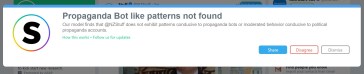
Or that it does:


Once I found this Twitter user, I started clicking on some of the things that he retweeted and sure enough those posters were identified as potential propaganda as well. Fascinating!
Do you know of tools like Botcheck.me or other companies doing similar work? If so, we’d love to hear about them. Please share with us in the comment section below or email us at contact@datagami.blog.
The next post in this series is now available — Disinformation: An Ounce of Prevention


 BI Over Beers
Leave a comment